Class History
The Renaissance Three
The Constellation refit initiative that gave rise to the Sagan class and reshaped early twenty-fifth-century Starfleet design
Overview
The Renaissance Three did not begin as a new class of starship.
They began as an experiment.
In the years following the recovery of the Borg Artifact, Starfleet engineers found themselves in possession of something unprecedented: decades of technological advancement recovered from one of the Federation’s greatest adversaries.
The question facing Starfleet was not whether the technology worked.
The question was whether it could be understood, adapted, and trusted.
Rather than immediately incorporating Borg-derived systems throughout the fleet, Starfleet authorized a limited modernization program using three aging Constellation-class vessels.
The objective was straightforward.
Test the technology under real operational conditions.
The outcome would reshape Starfleet for a generation.
The Artifact Program
The Advanced Starship Design Bureau, working alongside the Starfleet Corps of Engineers, selected three Constellation-class hulls for extensive modernization.
The choice of the Constellation class was deliberate. Although no longer considered a front-line design, the platform possessed a warp geometry particularly well suited to the deep-space propulsion and systems testing required by the program. The vessels were readily available, structurally sound, and extensively documented after decades of service, making them ideal candidates for experimental integration work.
There was also a symbolic dimension to the decision. Following its recovery, USS Stargazer had originally been considered for preservation within the Fleet Museum. Instead, Starfleet elected to return the vessel to service as part of the modernization initiative. The decision reflected a growing belief that the Federation’s future would be built not only through new construction, but through the renewal of proven foundations.
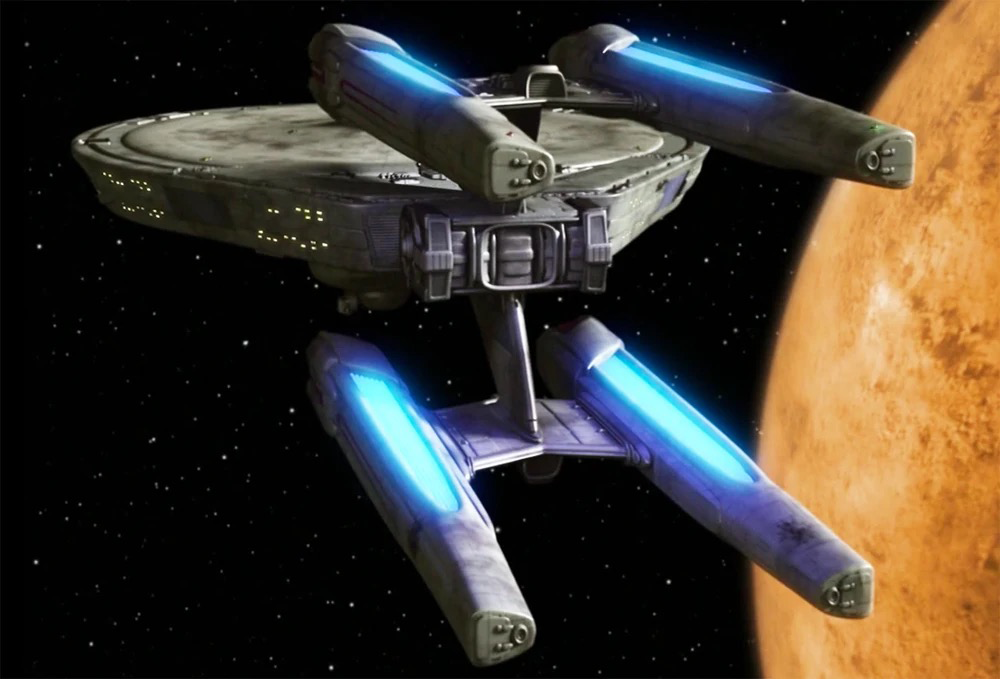
Each vessel would receive a different category of Borg-augmented technology.
Rather than evaluating the systems in laboratories or controlled exercises, Starfleet assigned the ships to active frontier deployments where performance could be measured under real-world conditions.
The program was officially classified as a Constellation Refit Initiative.
History would remember it differently.
USS Sagan
USS Sagan served as the propulsion testbed.
Engineers integrated Borg-derived advances into the vessel’s warp systems, power distribution architecture, and propulsion management systems.
The objective was not increased speed.
It was endurance.
Early deployments demonstrated that the vessel could sustain high-warp operations for extended periods while maintaining system stability beyond projected expectations.
The resulting data would become the foundation for a new generation of Starfleet propulsion systems.
USS Hathaway
USS Hathaway received the program’s tactical modernization package.
Experimental targeting systems, defensive coordination technologies, and weapons management architectures were integrated throughout the vessel.
While less publicly celebrated than the propulsion and sensor programs, Hathaway’s deployments demonstrated significant improvements in tactical awareness, defensive response times, and fleet interoperability.
Many of the systems first tested aboard Hathaway would later become standard throughout Starfleet.
USS Stargazer
USS Stargazer became the sensor platform.
The vessel received Borg-augmented sensor architectures designed to improve long-range detection, anomaly characterization, and scientific analysis.
The program’s most visible success occurred in early 2401 when Stargazer was dispatched to investigate an unprecedented spatial anomaly beyond Federation space.
The mission would later become notable for initiating renewed contact with the Q Continuum and for the temporary displacement of key personnel into an alternate twenty-first-century timeline.
While those events dominated public attention, post-mission engineering assessments focused on a different conclusion.
The sensor systems had performed beyond expectation.
The technology worked.
Frontier Day
Contrary to popular belief, the entire fleet was not present at Earth during Frontier Day.
The three experimental refits remained assigned to active frontier operations.
Their absence was not accidental.
Each vessel was considered mission-critical and remained committed to ongoing assignments beyond the Sol Sector.
In retrospect, that decision proved significant.
While Frontier Day exposed the risks associated with excessive centralization and fleet-wide integration, the Renaissance Three continued operating independently across Federation space.
The program’s emphasis on distributed capability and regional autonomy suddenly appeared far more relevant than anyone had anticipated.
The Sagan Decision
Following completion of the shakedown deployments, Starfleet reviewed operational data from all three vessels.
The conclusions were unexpected.
The modifications had altered the platforms so extensively that describing them as Constellation-class refits no longer reflected reality.
The first formal designation change occurred with USS Sagan.
The vessel was reclassified as the lead ship of a new class.
The Sagan class was born.
Technologies that successfully completed operational evaluation aboard Sagan, Hathaway, and Stargazer were subsequently propagated throughout the new class and incorporated into additional fleet modernization efforts.
What began as an experimental refit program had become the blueprint for Starfleet’s future.
Legacy
Historians would later refer to Sagan, Hathaway, and Stargazer collectively as the Renaissance Three.
The name reflected more than a successful engineering initiative.
The three ships represented a period of renewal in Starfleet thinking.
They demonstrated that innovation could emerge from existing foundations, that lessons could be learned from former adversaries, and that resilience often depended upon distributed presence rather than centralized power.
Most importantly, they proved that the frontier remained one of Starfleet’s greatest laboratories.
The technologies validated aboard the Renaissance Three helped define the fleet that followed.
The philosophy they embodied helped define the Federation that followed.